A high-performing business website is one of the most
effective digital assets for generating organic sales. When properly optimized,
a website can attract qualified traffic, improve search visibility, build brand
trust, and convert visitors into leads without relying entirely on paid
advertising.
For B2B companies and service-based businesses, the website
is often the first and most important touchpoint in the buyer journey. If the
structure, content, speed, and conversion flow are not optimized, valuable
traffic may not convert into measurable revenue. That is why website
performance, SEO, and conversion rate optimization must work together as a
single growth system.
Why a Business Website Must Be Revenue-Focused
Many websites are built to look attractive, but not to
perform commercially. A revenue-focused website is designed to support business
goals such as lead generation, demo requests, quote submissions, and
consultation bookings.
A strong business website should do the following:
When these elements are in place, the website becomes a
scalable organic sales channel.
How Organic Sales Are Generated Through a Website
Organic sales start when a user searches for a solution and
finds a relevant page on your website. If the page answers the user’s question,
establishes credibility, and presents a clear next step, the probability of
conversion increases.
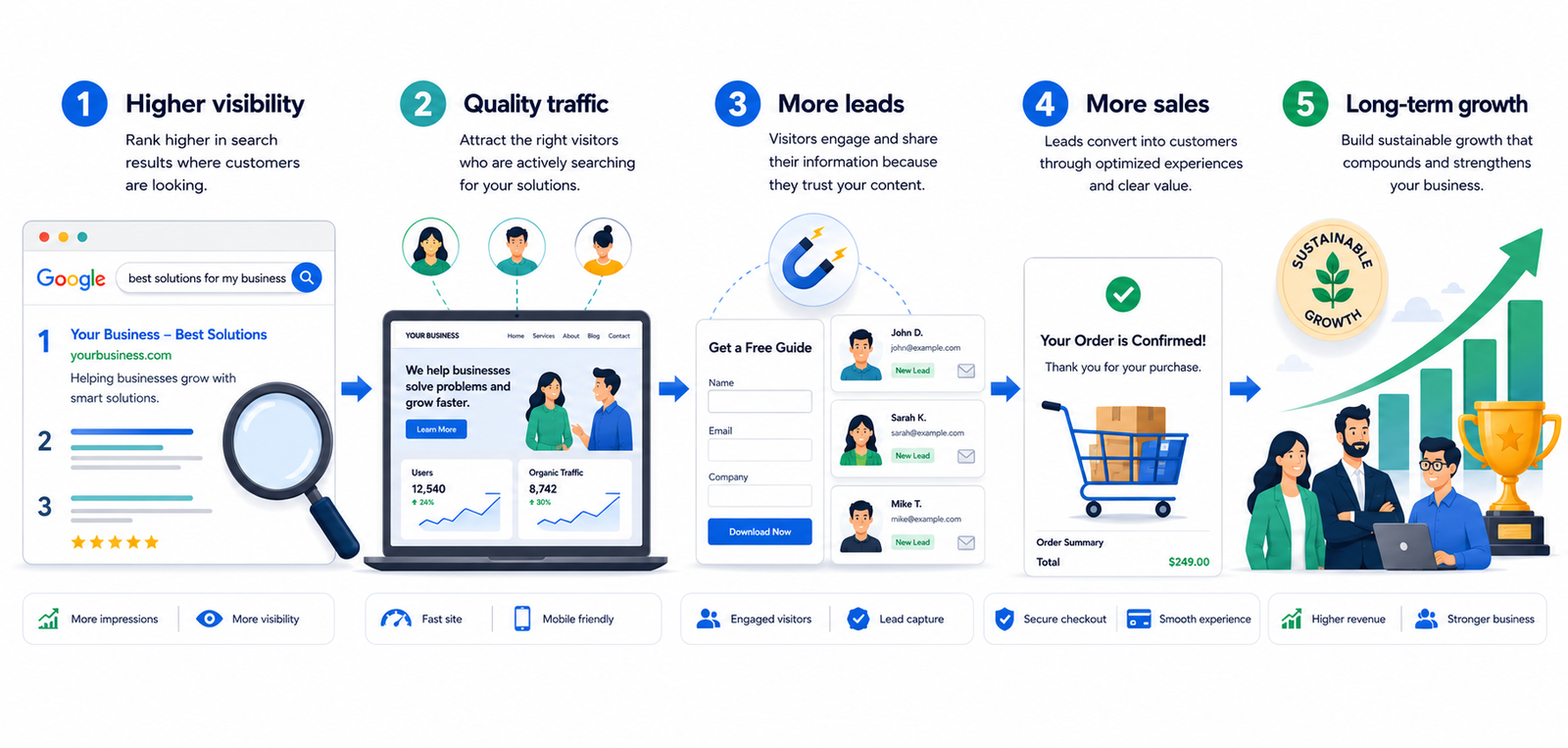
The organic conversion funnel typically follows this path:
Each stage must be optimized to reduce drop-off and improve
lead quality.
Core Elements of a High-Performing Website
A high-performing website is built on both technical and
strategic foundations. The following elements have the greatest impact on SEO
and conversion performance.
1. Search Engine Optimization
SEO improves visibility in search engine results pages and
helps your business attract users with strong intent. This includes keyword
optimization, metadata, internal linking, content depth, schema markup, and
crawlable site architecture.
2. Site Speed and Core Web Vitals
Page loading speed directly affects user experience and
search rankings. A slow website often leads to higher bounce rates and lower
engagement. Optimizing image compression, caching, code efficiency, and server
response time is essential.
3. Mobile Responsiveness
Most users access websites from mobile devices. A
mobile-optimized website must maintain fast load speed, easy navigation,
readable typography, and accessible CTAs across all screen sizes.
4. Conversion Rate Optimization
A website should be built to convert traffic into leads.
This requires high-intent calls to action, strong form placement, persuasive
copy, and minimal friction in the user journey.
5. Technical Structure
Clean URL structure, proper heading hierarchy, crawlable
pages, XML sitemaps, and canonical tags all support better indexing and
visibility.
6. Trust Signals
Testimonials, client logos, certifications, case studies,
and proven results reduce buyer hesitation and improve conversion confidence.
SEO Strategy for Organic Sales Growth
SEO is not only about rankings. It is about attracting the
right audience and moving them toward conversion. For this reason, SEO should
focus on buyer-intent keywords rather than generic traffic terms.
A strong SEO strategy should include:
Examples of high-intent keyword categories include:
These keywords help capture users who are already in
research or evaluation mode.
Technical SEO Factors That Impact Sales
Technical SEO plays a critical role in website performance
and organic visibility. If search engines cannot properly crawl, index, or
understand your website, rankings will suffer.
Important technical SEO factors include:
When technical SEO is handled correctly, it improves
discoverability and supports higher organic traffic quality.
Conversion Optimization Framework
Traffic alone does not generate sales. The website must be
structured to convert users efficiently.
A high-converting website should include:
This creates a smooth user journey from interest to inquiry.
Roadmap to Improve Website Sales Performance
A structured roadmap helps convert a standard website into a
revenue-generating asset.
Step 1: Audit the current website
Evaluate SEO performance, page speed, bounce rate,
conversion paths, and content gaps.
Step 2: Define target keywords
Identify commercial keywords that match your services,
audience intent, and business goals.
Step 3: Optimize key pages
Improve homepage, service pages, landing pages, and contact
page copy for clarity and conversion.
Step 4: Add supporting content
Publish blog content, case studies, FAQs, and industry pages
to increase topical authority.
Step 5: Strengthen technical SEO
Fix crawl errors, metadata issues, broken pages, mobile
issues, and structural weaknesses.
Step 6: Improve CTAs and lead capture
Make it easy for users to book a call, request a quote, or
submit an inquiry.
Step 7: Track and refine
Monitor keyword rankings, organic traffic, CTR, conversion
rate, and lead quality to guide future improvements.
Practical Business Case Study
A B2B company with a visually appealing website was
receiving traffic but very few leads. The website had generic content, weak
keyword targeting, and unclear CTAs. After restructuring the homepage,
optimizing service pages for high-intent keywords, improving page speed, and
adding case studies, the company saw stronger engagement from organic traffic.
More importantly, the quality of leads improved because
visitors were reaching pages aligned with their search intent. This reduced
wasted traffic and improved sales efficiency. The result was not just more
visitors, but better conversion outcomes and stronger ROI from organic search.
Website Sections That Influence Revenue
The following pages have the highest impact on organic
sales:
Each page should serve a specific SEO and conversion
purpose.
What Most Websites Miss
Many websites fail because they lack one or more of the
following:
Fixing these areas can significantly improve both rankings
and sales performance.
Frequently Asked Questions
How does a business website increase sales organically?
A business website increases sales organically by ranking
for relevant searches, attracting qualified visitors, and converting them
through optimized content and lead capture.
What is a high-performing website?
A high-performing website is one that loads quickly, ranks
well, builds trust, and converts visitors into leads or customers.
Why is technical SEO important for business websites?
Technical SEO ensures that search engines can crawl, index,
and understand your website properly, which supports better visibility and
performance.
Which pages matter most for organic sales?
Homepage, service pages, landing pages, case studies, and
contact pages usually have the biggest impact on conversion.
How can I improve website conversion rates?
Improve your CTAs, trust signals, page speed, content
clarity, and user journey while tracking visitor behavior and lead submissions.
At Incredible Softwares, we help businesses turn technology into growth engines.
📞 +91-8010421613
🌐 https://www.incrediblesoftwares.in